Some feedback on the new Heath pool system

Hey guys,


first of all: I love Rebellion and I really like the direction Sins 2 is going!


I tested the new damage system recently and got interested on the topic of weapon-health interaction in sins 2 in general.


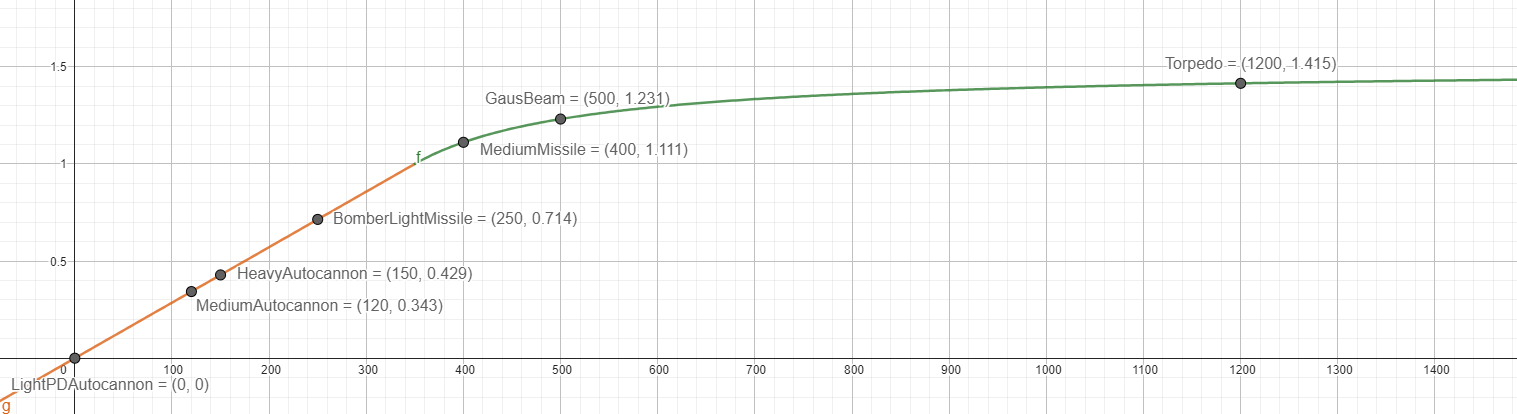
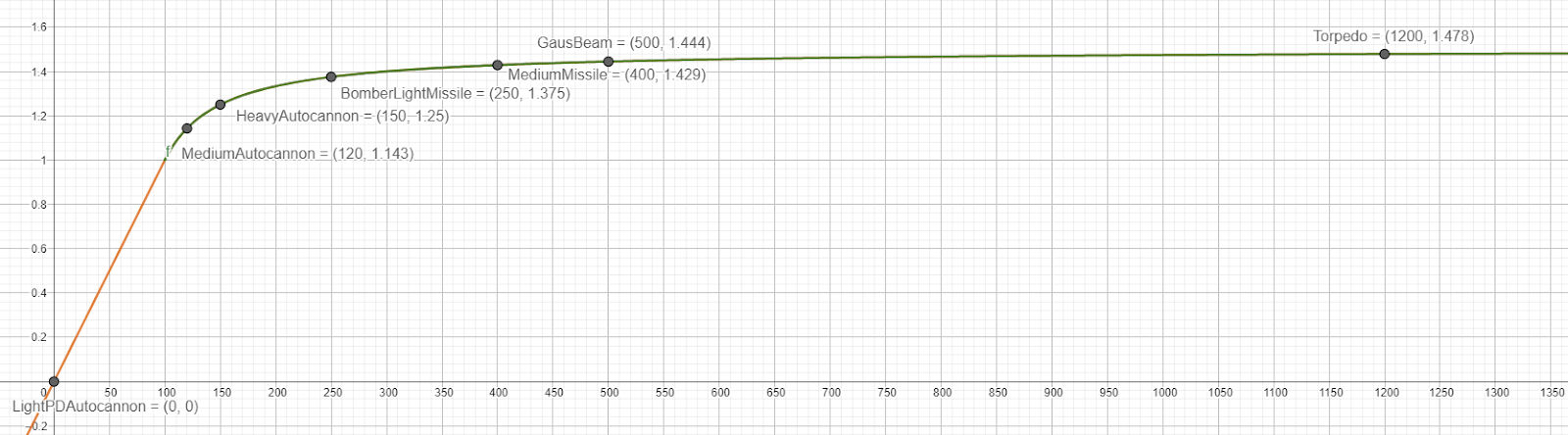
After reading the latest patch note I tried to see how exactly the system worked and made myself a graph plotting the damage modifier to piercing: 

Defending Ship: Hacka, durability = 350 scalar_per_durability = 1 (x=piercing)


Defending Ship: Cobalt, durability = 100 scalar_per_durability = 1 (x=piercing)
 

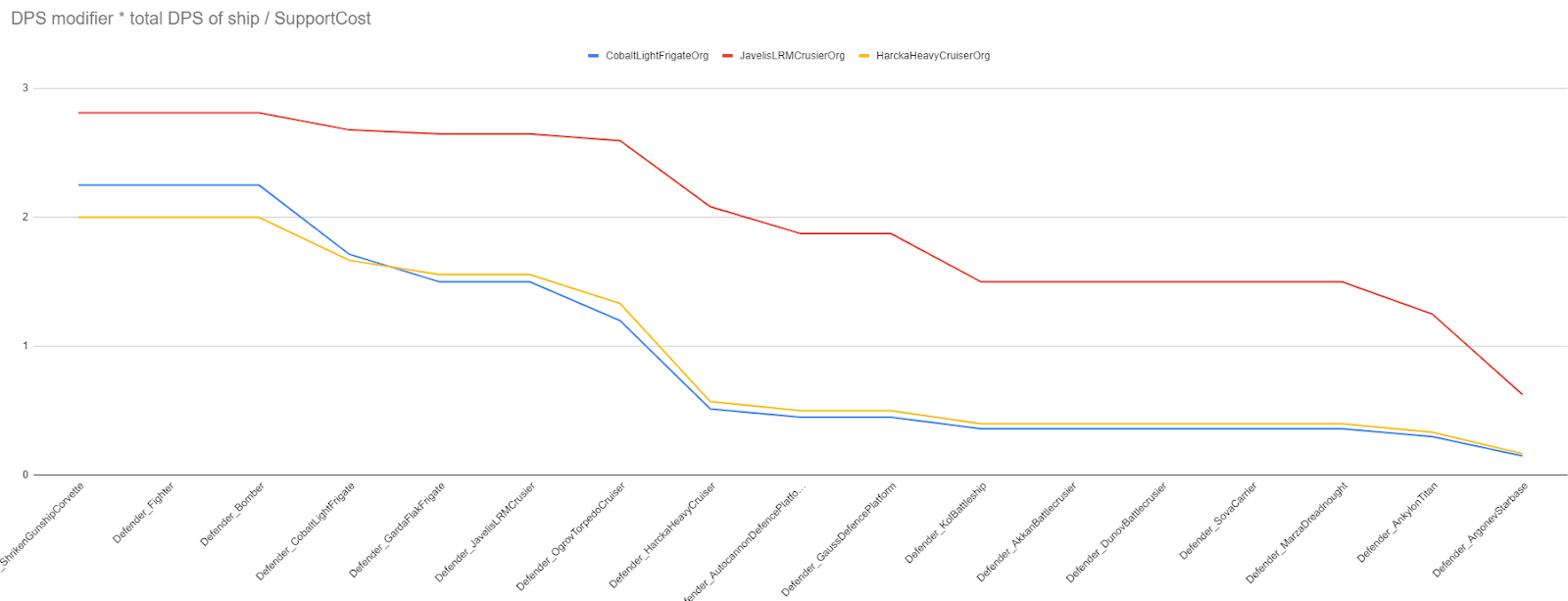
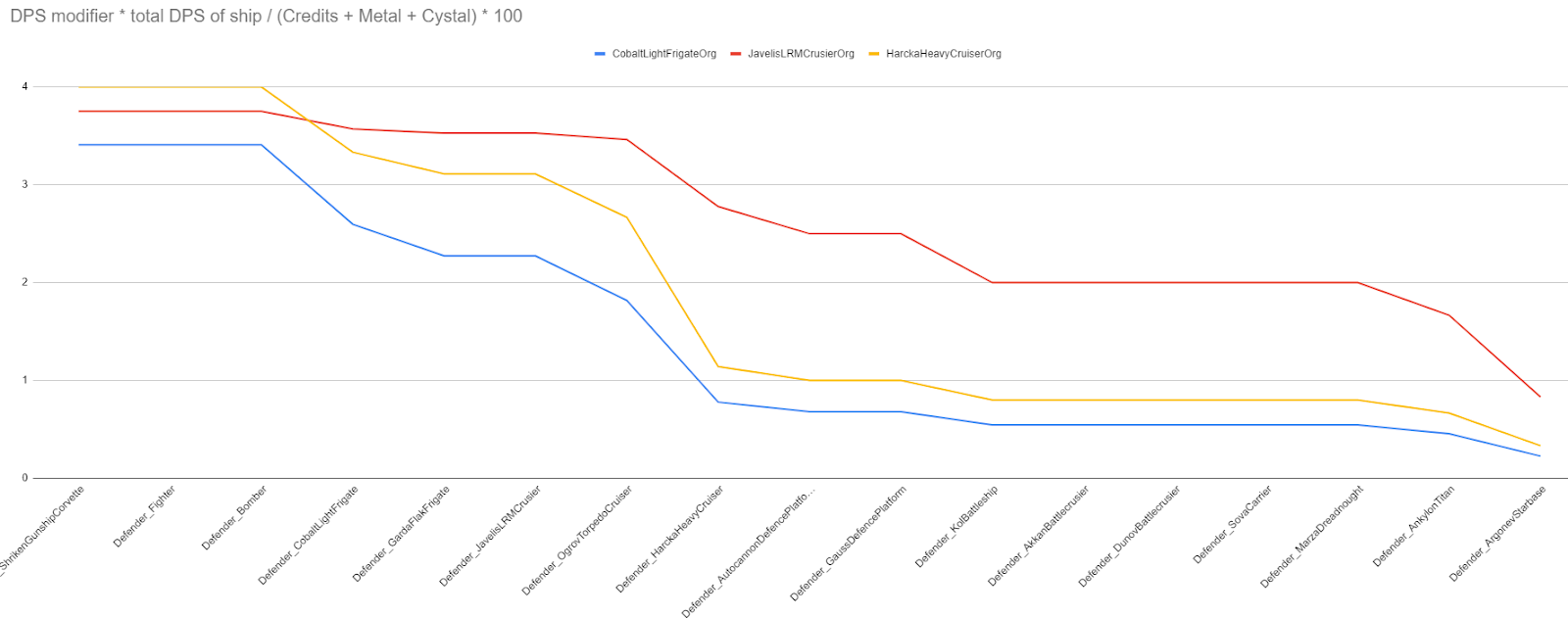
With this charts to start i checked additional factors like Supplycost or Recurces cost in this sheets (calculated effectiveness TEC Loy vs TEC Loy with scalar 1):

https://docs.google.com/spreadsheets/d/1D3YD_-X8nutUqzEdv299slAN9HziBEqYor3btErQZ9I/edit?usp=sharing


In my understanding of the current Damage system high Piercing is key regardless of the targets Durability.

Therefore I would summarize the current concept with a clear winner of Med missiles:  

  • you get bonus damage against most of the targets

  • Good cost effectiveness (supply and Resources)

  • on mass hard to counter

  • High alpha for high value Targets


I expect more death blobs and no real counterplay of enemy fleet compositions.


My mental idea would be like this:

I'm a Tank with 100 durability. if i have enemies shooting at me with small arms the make net to no damage at all. As the piercing power increases, damage goes up. As soon as I use the right gun for the Task I get 100% Damage done. After the piercing is enough I would think the damage and piercing is still increasing but the effectiveness to apply it to the target drops. I imagine it is like an over penetration of projectiles. yes you still penetrate but it won't explode at the right time therefore doing less damage.


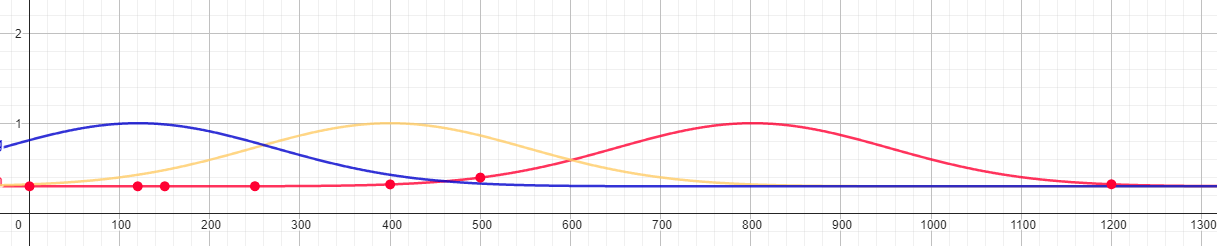
That's why i would suggest a graph like this:
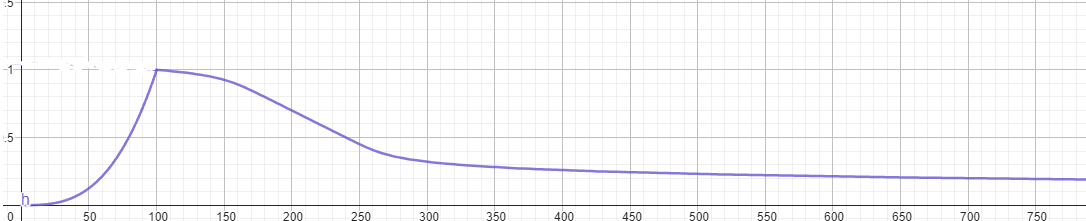
 

The Idea is you need the fitting weapons for the right targets to have your maximum damage potential. An advantage i would see is the possibility to create an arms race with research and having specialized weapons for different health pools.

E.g.

There is a Capital ship: 

500 Durability

4000 Hull

2000 Armor

200 Armor Strength

3000 Shield

-380 Shield Strength


If we begin with Damage against shields i would calculate like this:

EffectiveDurability = Durability + ShieldStrength - Piercing

The low durability would make huge weapons less effective and encourage smaller ships with smaller guns to take down the shields. The lower you can push the durability the more you force your enemy to downsize the howl fleet to Bombers Light frigates etc.


Next is the Armor

EffectiveDurability = Durability + ArmorStrength - Piercing

As the effective Durability is high you force bigger guns or missiles to receive huge amounts of damage (shields reversed).

Hull is a mix of both but as Armor and Shields are regenerating you still need a good fleet mix.
How would this look like?
Light Frigate has 120 piercing and 7.5 DPS:

Shield EffectiveDurability = 500-380-120 = 0

Perfect fit = 100% damage

Armor EffectiveDurability = 500+200-120 = 580

580 remaining is way to much to be effective = 20% Damage

Hull Durability = 500 - 120 = 380

 380 remaining is to much to be effective = 35% Damage


Titan has Beamweapons 500 Pircing and 50 DPS

Shield EffectiveDurability = 500-380-500 = -380

Overpenetration = 80% damage

Armor EffectiveDurability = 500+200-500 = 200

200 remaining is to much to be effective = 60% Damage

Hull Durability = 500 - 500 = 0

Perfect fit = 100% damage

with this system you could give the Races a distinct counter size of ships to be effective:

Advent shield focus would mean you bring more smaller ships to fight

Tec more heavy and big ships

Vasari you would like to have a medium sized fleet focused.

Therefore you have to prepare per race and can get caught in bad shape if you are getting attacked.

With research you can enhance your armor durability or decrease your shield durability, but also increase piercing of the weapons. That means if you are 2 research options ahead with durability compared to piercing you could incoming damage by 30% which is more worthwhile than 20% increasing HP but if the enemy catches up to 1 research option you only receive 10% less damage and you have better options with HP upgrades.

This would increase the meaning of research options and a tech advantage.


My main advantage of the system is there are no hidden multipliers so if you know the concept of the graph there is no math needed to understand what to do to coulter certain enemy compositions.


I would love to hear some feedback on my thoughts.


Sorry for some not polished sentences, i'm not an english native speaker.


Have fun!


45,962 views 13 replies
Reply #1 Top

That's right. Under the current damage formula, the star based base and defense facilities appear very fragile. In the past, the VASARI interstellar base could defend the player's planet with good positions, allowing the player's fleet to have the ability to do other things. But now players need to cooperate with the main fleet to achieve this, considering that there must be more evil AI fleets than players, this seems very inappropriate.

(Sorry, my native language is not English either)

Reply #2 Top

Can you share the raw data you've gathered?

I'm interested in the dps, pierce, cost and supply values for each ship, that I assume are the basis for your graphs.

Thank you!

Reply #3 Top

For the graph based on this Post at section Durability and Penetration Calculations (simplified):

https://forums.sinsofasolarempire2.com/525851/the-art-of-war-update---sins-of-a-solar-empire-ii

https://www.geogebra.org/graphing/akkaqkaz

For my personal suggestion:

https://www.geogebra.org/graphing/yg9wdvvz

In both cases you get the damage modifier applied to DPS

if you want an overview of how the original with scale 1 looks like i made a spreadsheet here:

https://docs.google.com/spreadsheets/d/1D3YD_-X8nutUqzEdv299slAN9HziBEqYor3btErQZ9I/edit?usp=sharing


Keep in mind thats data only based on the coding shown in the patch notes and not the final damage you see applied in game as I assume there are some hidden modifiers. E.g. scalar could change depending on the fighting pair, or bonus damage is applied heavy ship vs light ship etc.


Reply #4 Top

here's some dps, pierce and supply values for selected ships, taken from the game's tooltips, no upgrades


  Sulsurak Defensor ravastra skirmisher kanrak assailant kortovas oppressor vulrak penetrator cobalt light frigate javelis lrm cruiser harcka heavy cruiser ogrov torpedo cruiser
dps 7,4 10 12 20 10 7,5 15 20 5
pierce 0 120 400 180 1200 120 400 150 1200
supply 5 7 6 16 18 5 8 15 12
dps/supply 1,48 1,428571429 2 1,25 0,5555555556 1,5 1,875 1,333333333 0,4166666667


some data for selected weaponry of a level 6 vorastra, with, i believe all upgrades and desperation:


  vora wave vora missiles vora phase cannon
dps 950,4 538,2 194,4
pierce 240 500 1200


Barring missiles, I think it's fair to conclude, that as pierce goes up, dps goes down. Thus already leading to exactly the scenario you're wishing for: if you use the weaponry, with a pierce value closely matching the defender's durability, you get the most bang for your buck (or supply ...)
Low pierce, high dps weapons are incredibly ineffective against high durability targets, low dps high pierce weapons, just have low dps and are thus really only effective against high durability targets

Missiles seem to be overtuned in that regard. I assume, that's because you can shoot them down, before they get to deal damage, effectively lowering their dps.
Titan weaponry can be a bit whack in that regard. I have no clue why the Vorastras beams are just ... bad

Let me know, if I'm missing something or if my quick and arbitrary selection of data has biased my conclusion unfairly.


As to the effective dps calculations - I assumed scalar_per_durability to be constant, independent of the defender's durability. It already gets multiplied to the durability in the formula, justifying the variable name.
I also assumed its value to be 1/100.

Additionally, I'm unsure, if having more pierce than the defender's durability increases the damage. The formula in the dev post begins with

effective_durability = max(durability - penetration, 0.f)

of course, they do include a calculation for the case that happens to be lower than 0. It's confusing ^^

Reply #5 Top

Ok i Updated my Spreadsheed i linked above with the charts. You can make yourself a copy and click the Ships in original or my suggestion as you like.

As you can see on this chart the DPS per Supply cost is straightforward and is missing a choice between dedicated specialists per Durability

The lesser dps per Weapon size doesn't work as it seems.

On weak ships autocannons are more cost effective but as the heavy cruiser is more DPS per Supply and more DPS per Cost there is no reason to choose the light frigate (offense stats only)


I try to implement the rest of the ships as well and try to create a DPS per HP graph soon.

Reply #6 Top

Why did they feel the need to reinvent the wheel?

Keep the games original damage formulas and ships...copy/paste to the new engine and start Sins 2 upgrades from there.

Reply #7 Top

Quoting wbino3556, reply 6

Why did they feel the need to reinvent the wheel?

Keep the games original damage formulas and ships...copy/paste to the new engine and start Sins 2 upgrades from there.

Glad to hear you don't think the game is just a reskin anymore! <3  

I'm confident that someone will come along and mod the game to your expectations at some point. We're paying attention to all feedback and we're incorporating what we can as it makes sense to our goals.

I've directed our balancer at this thread, and I'm glad someone did point out that the missile spam concern does get countered by point defense. I've seen this play out in a recent internal playtest myself where someone tried to maximize their med missile damage and got totally countered by having a chunk of Defensors in the oppossing fleet. The new simulation is very complex, much more so than the previous game. There is a lot to account for and we appreciate everyone digging into it and trying to understand how it works!

+1 Loading…
Reply #8 Top

Quoting wbino3556, reply 6

Why did they feel the need to reinvent the wheel?

Keep the games original damage formulas and ships...copy/paste to the new engine and start Sins 2 upgrades from there.


I disagree. I really like the direction the new game is going. They are improving the game in many ways (really love how fleets actually work in this game as that was a missed opportunity in the first) and I like how they are actively making even the factions very different from one another rather than just minimal changes as previously. 

+3 Loading…
Reply #9 Top

Hi again,


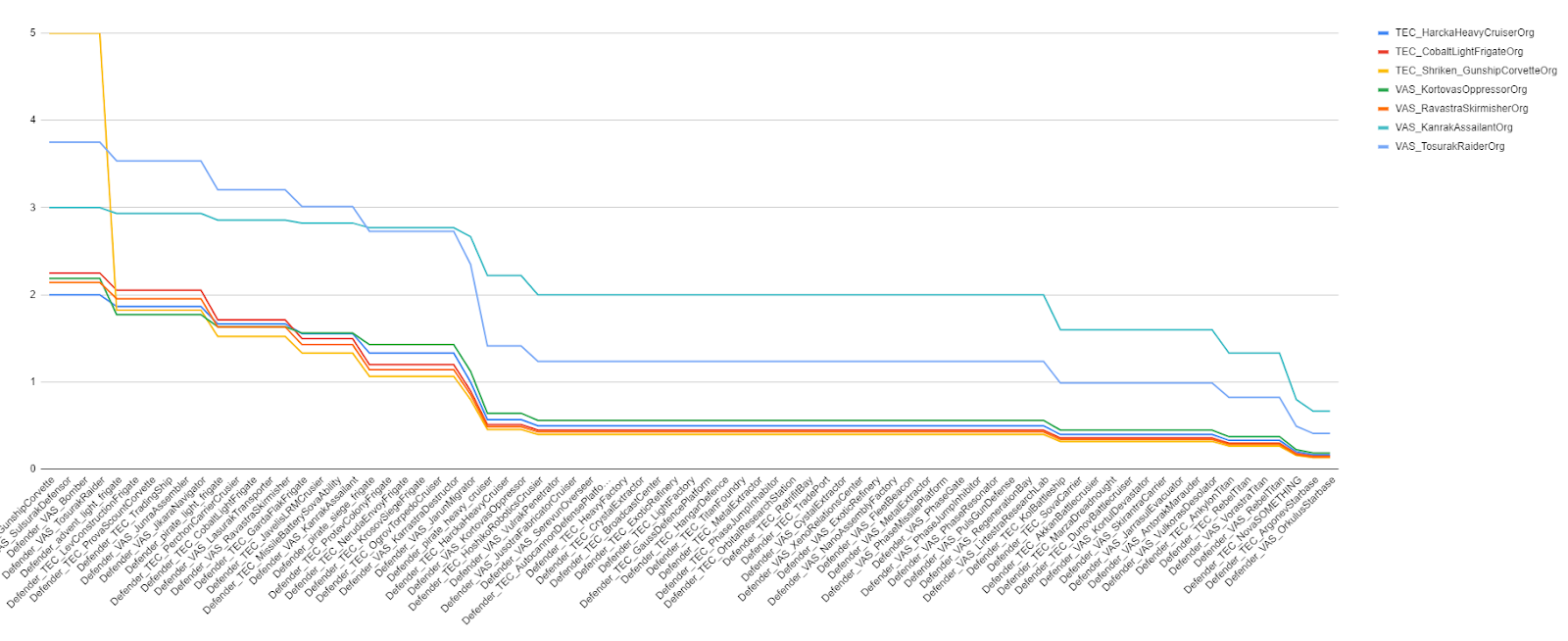
to prevent misunderstandings i want to clear up my opinion. I crunched some additional numbers and got this graph:

DPS of the specific Ship * Durability logic modifier / specific Fleet support cost


What I think I'm seeing is that all ships have the same trend. Good vs light Durability bad against heavy. What I'd like to see is having each ship type its own peak. Excel at destroying heavy medium or light ships but mediocre or bad at other ship types like this(oversimplified):

Let's say: 

Missile Cruisers are good against Heavy Tagests but really bad against Light representing RED

heavy cruisers are good against light but bad against heavy ships representing Blue

Light ships are effective against med ships but not against light or heave representing yellow.


Whatever combination you choose or how you implement it i´d like to see a distinctive rock paper scissors system where specialicing gets rewarded significantly until you get countered and have to adept. If you choose to build a mixed fleet from the beginning the damage has to be as much reduced to lose to any specialized fleet there is of the same size. Only then it makes sense to specialize in the first place.

It's true you can tweak the same with Supply cost, but i prefer Supply be a nuance not a major tweak

Cost should have a mediocre impact on fighting capabilities but I do see the interesting gameplay and strategies you could switch on to stay at supply cap for an extended period of time as a reward for a good economy.

I love the ability to shoot down fighters and Missiles with PD and it is really interesting in the game. But at the moment it feels like Rock and scissors but missing the paper. And to be honest i don't really have an idea what the paper could be (something like fighters?)

In the end i like to express my gratitude for some good opinions and concerns!


If someone want additional data just post what you want to have calculated in which way and i can give you some Graphs or sheets,


Reply #10 Top

I didn't know about the damage modifiers Sins1 had until about 2 years ago - unlike WC3 there wasn't any indicator that such a system was present. If things wind up returning to that state then I'd prefer they are visible as tooltips on the units in Sins2.

As for thoughts on your idea, I'm wary of setting it so that "overpierce" results in less damage overall. Mostly because it's fun/cool to watch the Ragnorak titan eviscerate cruisers/frigates that get caught in its sights. I'd like a similar result to occur for a capital ship attacking a corvette. I think your idea has been to go-to approach for ages now as its probably easy to setup (aside from the initial argument that predetermines what the winning sequence will be set as, at least until the next balance patch).

  • I am fond of the idea of ships having durability ranges set by class type, where order of durability would ramp up as: strikecraft > corvettes > frigates > cruisers > capital ships > titans. When it comes to structures; civilian structures would be a little more durable than corvettes, military structures would be more durable than cruisers and starbases would have durability similar to titans.

I do like the idea of weapon types having mostly set pierce levels - autocannon, gauss, missile, torpedo, wave, beam, pulse (& then whatever the advent wind up bringing to the table). Although I worry that could lean heavily into one of your concepts - where you use different weapons against different enemy factions. One on hand, its certainly realistic & encourages switching gears. On the other, doesn't that mean you HAVE to use the correct fleet composition otherwise you cannot fight at all? For example, I really don't want to be pigeonholed into only using harkas against the vasari & only using gardas/cobalts against the advent - assuming I'm understanding your intentions for "distinctive rock paper scissors system where specialicing gets rewarded significantly until you get countered and have to adept."

  • Your approach assumes that players have the opportunity to respond. RTS in general tends to be over after the first deathball is broken; right now maxing defense structures with a fully setup starbase will fall in about 5-10min to a sustained 300 supply (from watching my insurgency wreck the cultureless AI who had well entrenched planets). When defending, If I micro my starbase into eliminating the frigates/cruisers in range first, I can extend the time it buys me somewhat but my starbase getting destroyed if my fleet is more than 3 jumps away. If all my planets had ship factories I might be able to rebuild 2000 supply in a few minutes - but they wouldn't be located where I need them and I don't think they would have the opportunity to regroup in time.
  • Another aspect of forcing a hard rock/paper/scissors - can I assume you mostly play 1v1 or team vs team scenarios? I tend to favor large maps as a FFA and I can have 2-3 AI attacking me in various places while I'm either pushing into enemy territory or fending off an opponent elsewhere. Am I to scuttle my fleet between or during battles? Because with a strict rock/paper/scissors system, no amount of scissors I throw at a given rock will do anything even though I need those scissors to stay alive against a different opponent. 
  • I may be pushing harder into the counters than you'd intend to go, but I prefer soft counters over hard counters. Soft counters are expensive (and thus inefficient), but I'd rather be able to barely stay in the game using the wrong tool if I can back it up with an economy instead of getting sent to the start menu because I was just wrong place, wrong time.

Something else I've seen suggested before is ship mobility - smaller ships are always less durable, but they can be more mobile.

  • Corvettes already have their attack pattern
  • Frigates could be given the ability to strafe while still facing their target
  • Cruisers would be technically able to strafe, but the reality is they're too large to really "dodge" that much
  • Capital Ships & Titans would retain their sit-and-shoot approach
  • With modifying ship mobility, 
    • Since non-missile weapons are always hitting (even if artwork implies otherwise), we can still mimic the "dodging" by tweaking the turret acquisition/turn speed parameters instead - shots that aren't fired can't hit you
    • If the turrets can't keep up, this would open up the possibility of the larger ships getting swarmed.
    • Abilities/components such as explosive rounds, flak or concussive barrages could then be used to engage fleets that are acting like army ants. The larger ships could be steered more towards assaulting planets and the immobile defensive structures.

Other concepts:

  • TEC fighters could be given the ability to attack missiles/torpedos as a priority. Vasari don't have interceptors (they do have more PD in their fleet I think), but TEC would gain an extra tool for dealing with inbound missiles
  • Projectile weapons (like autocannons) are set as close range in comparison to energy weapons

Ultimately I guess my reaction towards your idea of encouraging specialization is hesitance? But this stems from my philosophy, not your numbers. I favor adaptability & the jack-of-all-trades approach over putting all my eggs in one basket. Which I suppose is ironic, as I think I'm often begging for specializations in my requests.. sooo....

  • I want well rounded fleets to be viable and counter-able
  • I want carrier fleets to be viable and counter-able
  • I want heavy fleets to be viable and counter-able
  • I want swarmy fleets to be viable and counter-able
  • I want missile/torpedo fleets to be viable and counter-able
  • I don't know what any of these should look like when it comes to the numbers/graphs.

In any event, thanks for posting this - it gave me a much-needed break during lunch earlier today.

+3 Loading…
Reply #11 Top

Quoting AlissaFX, reply 9

Whatever combination you choose or how you implement it i´d like to see a distinctive rock paper scissors system where specialicing gets rewarded significantly until you get countered and have to adept. If you choose to build a mixed fleet from the beginning the damage has to be as much reduced to lose to any specialized fleet there is of the same size. Only then it makes sense to specialize in the first place.

Quoting Erebus6937, reply 10

Ultimately I guess my reaction towards your idea of encouraging specialization is hesitance? But this stems from my philosophy, not your numbers. I favor adaptability & the jack-of-all-trades approach over putting all my eggs in one basket. Which I suppose is ironic, as I think I'm often begging for specializations in my requests.. sooo....

    • I want well rounded fleets to be viable and counter-able
    • I want carrier fleets to be viable and counter-able
    • I want heavy fleets to be viable and counter-able
    • I want swarmy fleets to be viable and counter-able
    • I want missile/torpedo fleets to be viable and counter-able
    • I don't know what any of these should look like when it comes to the numbers/graphs.


Going to preface my comments here that while I'm a dev on Sins2 I'm not the one balancing units, so fret not if someone doesn't like my personal opinion here. Echo does a really good job of weighing the feedback he gets.


I have the same reaction as Erebus. I'm not a fan of monochromatic fleets or single damage type fleets. Creating a system that encourages pivoting from one monochromatic fleet to another is unappealing to me. That sort of design strategy may feel better in terrestrial RTS games, and I've seen folks complain about the viability of those kinds of fleets in Sins 1, but Sins 2 is a game where the focus is about fleet strategy and tactics. If your opponent has created a fleet that is best countered by something very focused, I think that should be viable to do, but I think building out a combat system that encourages that kind of play leads to very boring matchups and wastes the game's setting in futuristic space combat.


My preference is a holistic approach to fleet design where you have a variety of ships and the numbers of each class change based on what your opponent is building and where you're at on the research tree. There is countering happening, but you're not literally building a rock fleet to counter your opponent's scissors fleet. I'm in favor of encouraging a design that rewards treating a fleet as an integrated system of systems where all units work together to complete the task at hand, adapting as the match progresses and the battlefield changes.

Reply #12 Top

I do see both of your points. It’s true it's not fun to lose all your game just because you didn't predict right or you are not able to switch ship types fast enough. I'm glad you pointed it out because that's something I missed completely.


So what would be necessary to encourage some adaptation and changing fleet composition but still making you able to defend yourself if you are not in perfect shape.

If you have 2 Fleets with equal supply and you have 1 Fleet with bad composition the enemy should be making 10% more damage than you. That way you could compensate with abilities, smart aggro focusing or support cruisers but letting the enemy win by being equally good with better decision making.


On the other hand, to think about a good composition especially on the offense the performance per price should be like 30% reduced. That way I will still use all I have to defend myself but think about my ship choice to attack or to restock the supplylimt.

Reply #13 Top

I don't really approach this with numbers like supply, DPS or damage modifiers. Not to say those are irrelevant; I just don't think in that manner. To try & answer you're question though, this would be my thought process (note that I haven't put much work into compressing this, so apologies for trying to build the context I assume is needed for my answer).

Context:

  1. Establish ship classes as having several roles; a primary (ship main purpose) & then the secondary (ideally some kind of redundancy to an existing function, just not as 'good' as something dedicated)
    1. Note, my own philosophy is that "mother nature loves to disguise weakness as strengths"
  2. Smaller ships are less durable, but have high mobility. Larger ships are more durable, but have low mobility
  3. Logically, war is a conflict that is influenced by the following
    1. luck - skill & capabilities don't matter if you're wrong place, wrong time. Sins2 uses random events to simulate this, I think
    2. number of troops - quantity has more impact than quality. Not to say quality can't "win", but having fewer numbers means any losses are more severe. For Sins2, I think this is why the weapon/armor/effective-health upgrades don't really amount to much. You aren't likely to hold out if the supply difference is greater than 300-ish? (I need many more games to build confidence on this though). This being said, in my vasari exodus games, I like to play as capital ships + titans + starbases only.
      ~Without the starbase alongside my fleet and with my ship levels being 5+ as well as all ships equipped with items - the exodus fleet seems to hold out well against enemy AI fleets with twice the supply.
      ~That said, an enemy ragnorak does alot of damage against this. If the enemy AI wasn't so keen on retreating they could severely maim my fleet. Sure, cap ships are strong, but high burst damage like that floating railgun is VERY good against all-cap fleets. New cap ships don't come with an abundance of levels either..
    3. technology - tools are important. For Sins2, the components & various ship classes are unlocked, ideally giving you more options to hold your ground or take some from an opponent
    4. resources - Equipment & people don't randomly phase into existence.
    5. production capability - If you have the resources, you still need to be able to apply them
  4. Strategies (from game perspective)
    1. Strikecraft/corvette focused fleets - basically, the idea is to amass something cheap as fast as possible & not care about the losses. If larger ships like cruisers/caps/titans are set to be not as effective against a horde as they are against each other then you can just overwhelm them. For me, this is just cool to watch. Reminds me of the Formic from ender's game.
    2. strike fleets - fleets with a single purpose in mind.
      1. Could be something like a bunch of planet bombers sent in to knock out the planet before the starbase shields are online.
      2. Could be a bunch of heavy cruisers intended to knock out all of the civilian infrastructure to weaken opponents economy.
      3. Could be a bunch of missile frigates intended to overwhelm a starbases PD.
      4. Could be a bomber fleet intended to snipe high level enemy capital ships/titans.
    3. Anchor fleets - basically the default, well-rounded fleets that are adaptable. Most ships stick nearby each other to cover each others weaknesses
  5. Counters
    1. larger ships can be swarmed by smaller ships. So between abilities & components they can either do AOE damage (which is more effective against smaller things) or increase their survivability. These larger ships may have abilities that can "clear" out large numbers of little ships, but the thing with the little ships is that they are easily/quickly replaced. Larger ships aren't intended to combat these little ones directly. Their AOE damage/survivability abilities are meant to buy time to react. If they stay where they are, they'll eventually get overrun. They could use the reprieve to retreat, or they could use the reprieve to attack the source of those little ships (they're coming from somewhere). If the game is set up to my liking, large cap ships can't indefinitely clear away swarms (flak bursts could be set as components with usage limits)
    2. strike fleets are really good against their targets, but presumably weak to anything else.
      1. planet bombers - planet shields, defensive structures, garrisons, hangar defenses & nearby fast ships like corvettes should be able to reach the frigate planet bombers and knock them out or thin them out long enough to get the planetary shield online.
      2. heavy cruisers - likely weak to strikecraft/corvette swarms. They can also just sit & bash on each other too
      3. missile frigates - reduced effectiveness with PD sources around. fast little ships or strikecraft can be used to engage them as they typically outrange the structures they counter
      4. bomber fleet - reduced effectiveness against PD sources & fighters/corvettes. Or destroying their host ships could work too. AOE damage sources from items/abilities
    3. anchor fleets are where the numbers game comes into play. They don't have any particular weakness, so you just want to overwhelm them. Research upgrades to damage/effective-health can come into play here too. Anchor fleets aren't going to be fast and they can't be everywhere. So strike fleets can hit where they aren't.

The above was meant to help provide some insight on how I approach things, apologies if it didn't help.. I'm not sure how to simply explain all of that yet..

The Advent still think they're being sneaky and haven't really revealed themselves in the game yet. Most of the ship abilities (for non capitals/titans) haven't appeared yet. We have alot of variation potential from the asymmetry of each faction - some factions will have an easier time doing particular strategies (vasari exodus is probably best suited for a heavy fleet, considering its mobile nature, whereas TEC Rebels are more inclined towards strikes fleets I think, especially once Insurgency is up. TEC are probably better for swarmy fleets with their economy and the sovas serving as anchors in a strikecraft/corvette attack fleet. Vasari are probably better bomber fleets, considering they don't seem inclined to use fighters).

Map size & the number of players will make a difference too. Tiny 2 player maps won't see much of what the races offer. Massive 10 player maps will likely have most players with fully researched tech trees and large, established empires. Planet bonuses & artifacts are probably going to impact specific cases.

At this point in the game's development I don't really concern myself with picking the numbers that much, mostly because I can just tweak things to be more to my liking (I'm part of the PvE crowd, so mod compatibility isn't much of an issue for me). The kinds of strategies/counters I'd want to see are listed above but they aren't all inclusive. Defensive structures are a thing and I'm hoping to make some personal mods that would expand on the "Exploit" aspect of 4X, which would make owning particular planets better for some factions than others - which would impact the balancing at least slightly.