Moosetek13 Moosetek13

Is this where the U.S. is headed with Obamacare?

Is this where the U.S. is headed with Obamacare?

http://www.dailymail.co.uk/news/article-1298960/Woman-25-dying-blood-poisoning-texted-photos-deadly-rash-mother-doctors-ignored-her.html#ixzz0vCP3fK1E

Woman chronicled her own death from meningitis in phone pictures as doctors told her spreading rash was only a 'minor infection'

"The inquest heard there were only two doctors on duty to cover the entire hospital the night she died last November."


There is already a shortage of primary care doctors, and it seems likely to get much worse in the next decade. It just doesn't pay, anymore, to be one.

How much worse will it get if we start to lose ER doctors, and entire hospitals for that matter, because of the mandates and restrictions imposed by this ill-conceived health care (sorry, insurance) law?

It needs to be repealed before it does permanent damage.


http://www.telegraph.co.uk/health/healthnews/7920136/EU-rules-are-making-our-doctors-lazy-clock-watchers.html 


509,513 views 130 replies
Reply #101 Top

someone give the man a billy goat!!!


Reply #102 Top

Quoting psychoak, reply 96

Are there any Americans who seriously believe this system is going to bring the Apocalypse?


Apocalypse is a little strong of a word.  If you asked if it was going to cripple us economically, set us back 20 years, make 20% unemployment normal, and cripple the health care industry, I'd say we're already getting there just fine with Medicare.  Bush's Part D expansion is just the latest straw crushing the service side of the industry.  Just because you don't bother to educate yourself beyond the sob stories doesn't mean you aren't going down the swirly with the rest of us.  The lever was already dropped a long time ago.


Instead of letting shock and sadness rot your ability to observe and rationalize your settings, actually look at the system you're in, and how you got there.


The insurance industry you pay through the nose to partake of was created by government regulations.  All that nonsense you don't need but pay for anyway is mandated by multiple tier regulations all across the country.  Your inability to afford your own choice insurance policy is aided by mandates and tax breaks that force you to get insurance through your employer.  IfI can make a killing selling a thousand policies to one entity as a tax deduction, why would I give a shit about you?  If your employer is the one paying for it, how much are you going to care about how much you're spending? 


In some states, you get to pay for Viagra, cosmetic surgery, sex changes, all kinds of twisted shit you shouldn't be forced to purchase coverage for.  In a lot of states, you don't even have insurance to begin with.  You have prepaid medical.


It stands to reason that paying someone else to pay a bill is going to come with a premium, yes?  Why then would you want to buy "insurance" to pay your bills?  Insurance is for the car accident, not the oil change.


If we kill all the fucking lawyers, everyone gets life long catastrophic coverage policies and pays their own damn bill when they go to a doctor for a checkup, you could cut primary care costs in half overnight.


It doesn't cost a doctor sixty bucks to feel your throat up, look at it, and tell you you've got strep.  It costs sixty bucks to pay for the insurance your litigious asshole country has made him need, the two secretaries he needs to give your insurance company shit over paying a bill that should have been a momentary cash exchange, and all the Medicare patients he sees that are reimbursing him for half that while costing just as much.  Then there's defensive medicine, all those tests they like to run that have fuck all to do with whether or not the simple answer to a simple problem is easily verified, and everything to do with making sure you can't sue them if you're too stupid to go back in a few days when the antibiotics for your rash aren't working because it's really lyme disease.


edit:


Wrong.


Troll defeated.


Sure, because taxes are a figment of his imagination and you don't actually pay for government programs...

Wow, thanks for the essay but I'll just read the last bit. :/

I never denied the existence of taxes, don't pretend I did. Btw, tax isn't 'our money'. 'We' don't pay for things that are paid for by taxes. Taxes are the government's money, they can take however much or as little as they want to pay for their houses, that's the way it is. Don't kids yourself you have some right over where taxes go.

Now try your trolling and douche behaviour somewhere else, you'll gain no success in my presence.

Reply #103 Top

Ozzy, please say you have no plans to reproduce before your brain matures?  The only shot your offspring have at a decent education is if you have a brain when they're growing up and can give it to them.  The school system sure isn't going to make up for your current state.


What it comes down to is whether government run healthcare would be cheaper.


If this were the United States Socialist Republic, I'd agree with that.  I have a problem with you mandating what I have to do, even if it's good for me.  I should have the right to not get insurance and end up dying earlier than needed from something that could have been treated.  Quite frankly, some of you need a serious lesson in what money is in exchange for.  If you spend ten thousand extra hours slaving away to pay for the medical treatments that get you another thousand, you've burned nine thousand hours in futility just to be sick longer.  If I have to pay for prepaid medical, even through the government, it's not going to be worth it unless I hit the jack pot and get cancer in my 30's.  Catastrophic coverage is another thing entirely, but even while sensible it's still not something anyone else should be able to tell me I have to get.


It should be for this reason....

In the private system you have insurance companies that want to earn a profit.  The private run hospital wants to earn a profit as well.

If it is all done by the government it is done as nonprofit which means you cut out 2 profit margins making the cost for the consumer needing the healthcare cheaper.

If it is shown to cost more somewhere in a government run system then someone in that system is swiping the cash.


In theory, profit makes things more expensive because everyone has their cut.  In theory, government does things cheaper because they aren't trying to make a profit.  The joy of theory versus practice is that it's rarely something you can line up.


First, practical observation of the political body gives rise to an inevitable conclusion regardless of ones party affiliation and philosophical views.  This conclusion is that you'd have to visit a prison to find a more corrupt, incompetent, and generally all around useless group of individuals.  Do you really expect them to run something better than a person who needs to be efficient to stay in business would?  There are plenty of examples to see, and they say Congress can't take a shit without making a mess, let alone run a sixth of the US economy.


Second, as can be seen in long term effects where it's already been done, even if one manages an initially viable alternative, government, not having a motive for profit, does not innovate or even keep up with the times.  Many things have become drastically cheaper over recent years.  Powered wheel chairs for instance, Medicare is paying out twice what they sell for.  In countries where the profit motive has been taken out of the drug industry, it's shrinking or gone entirely.


Haven't you ever wondered why the US is the drug manufacturing capital of the world despite being more litigious than any other country by a vast margin and having the strictest testing standards at the same time?


In practice, congress is populated by 465 crooks that couldn't screw in a light bulb without looking for a way to profit from it first.  That's assuming the light bulb is still legal after it's been brought to their attention.

Reply #104 Top

In practice, congress is populated by 465 crooks that couldn't screw in a light bulb without looking for a way to profit from it first. That's assuming the light bulb is still legal after it's been brought to their attention.
\

That's why I said it "should be" cheaper.

Haven't you ever wondered why the US is the drug manufacturing capital of the world despite being more litigious than any other country by a vast margin and having the strictest testing standards at the same time?

That's because our drug companies would rather find something that will keep you alive with the condition instead of actually curing it.  If the gov't had to supply it they would spend more time looking for actual cures instead as that would be the cheaper route.  There are some things that can cure diseases that they won't test at the FDA so that we can't use it... One example would be bacterial phages..  These are bacteria that eat viruses but no one is legally allowed to test them in America because of the drug company lobbyists.


Reply #105 Top

The conclusion you draw from this questionable information is to put those same crooks that take payoffs from lobbyists and put them in charge of the whole deal?


I kinda figure that a group doing a bang up job with what they've got shouldn't be given more to fuck up.


To get it out in the clear, a bacteriophage(which is what I'm assuming you meant) is a virus that feeds on bacteria, if I'm wrong and you're really talking about bacteria that eat viruses, I haven't heard of them.  If they really are blocking the testing of something that will eat viruses, you've got a glowing recommendation to join the psycho camp staring you in the face.  I couldn't make a better argument to strip away their regulatory powers myself, and I could make hundreds off the top of my head if I were dense enough to belt out text in futility for the next several hours.

Reply #106 Top

I dont think you'd find too much disagreement that the private sector is better at running almost all industries. however,

Quoting psychoak, reply 103

Do you really expect them to run something better than a person who needs to be efficient to stay in business would? 

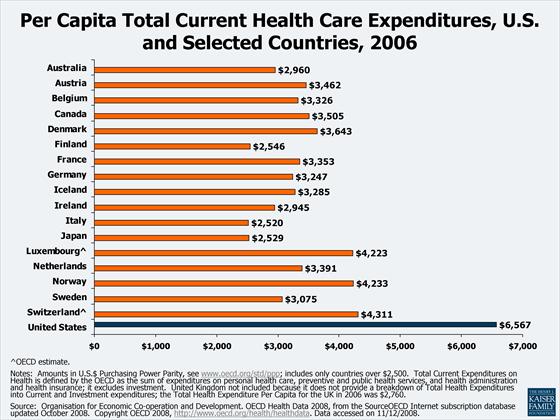
you need to explain why the the private sector has been largely incapable of producing affordable healthcare in the US thus far. I'm sure you've seen many of such graphs before, but anyway...

I cannot vouch for the veracity of the figures, but every single estimate i've ever seen has the US out in front by a substantial margin. If the private sector is so efficient, why are the costs so much higher, why do healthcare costs account for a staggering ~60% of bankruptcies and even more outrageously, why do 3/4 of said bankruptcies include people who had health insurance?

More than 75 percent of these bankrupt families had health insurance but still were overwhelmed by their medical debts, the team at Harvard Law School, Harvard Medical School and Ohio University reported in the American Journal of Medicine.

http://www.reuters.com/article/idUSTRE5530Y020090604

http://www.slideshare.net/ssilton/americanjournalofmedicine09

Do you at least accept there's a problem with healthcare affordability, and if so, what do you propose as solutions?

Reply #107 Top

Quoting Ozzy38, reply 102
I never denied the existence of taxes, don't pretend I did. Btw, tax isn't 'our money'. 'We' don't pay for things that are paid for by taxes. Taxes are the government's money, they can take however much or as little as they want to pay for their houses, that's the way it is. Don't kids yourself you have some right over where taxes go.

Let me guess - you are a shit stirrer.  because I doubt anyone can be as stupid as the things you write.

It is OUR MONEY.  The government TAKES IT in the form of taxes.  That is why you fill out a tax form!  Duh!

Regardless of your definition of WHOSE money it is, it is MONEY.  So it is not FREE.  Someone had to earn the money (apparently not you) for the government to TAKE it.  Have you ever heard of a homeless person paying taxes?  What with?  Their cardboard box?

Psychoak is right.  You should not reproduce.  I believe that would fall under the heading of child abuse to have you as a parent.

Reply #108 Top

Quoting -RAISTLIN-, reply 106
More than 75 percent of these bankrupt families had health insurance but still were overwhelmed by their medical debts, the team at Harvard Law School, Harvard Medical School and Ohio University reported in the American Journal of Medicine.
http://www.reuters.com/article/idUSTRE5530Y020090604

http://www.slideshare.net/ssilton/americanjournalofmedicine09

Do you at least accept there's a problem with healthcare affordability, and if so, what do you propose as solutions?

Here's the problem with that.  What happens when you declare chapter 13?  Chapter 7?

Let me give you a 10 second answer.  The former, you pay your bills - over a longer period.  Chapter 7 you walk away.

So how many of that 60% are chapter 13 versus chapter 7?

Second question: What happened between 1981 and 2010 in regards to bankruptcy?

10 second answer - it got tougher to declare.  In other words, the impact of medical bills has not magically skyrocketed, but the reason for filing has gotten stricter!  Medical bills are the leading cause of bankruptcies now because they are about the only thing left on the table where you can get into trouble ( I suspect the percentages will change after 2007 due to the housing bust).

The 2 links you quote are perfect examples of framing the debate to conform to an agenda.  Without the details behind the "grand" numbers, you cannot really conclude anything other than the numbers themselves.

Finally, I would ask you how mandating the buying of insurance - whether from a private company or the government - is supposed to reduce costs?  You ask what to do about the high costs, so I ask what has been done?

For a demonstration of what happens when you pump money into a system (instead of trying to reduce costs), just look at the American Post Secondary Education System.  The "government" has been issuing low cost loans for college education for many decades.  And in so doing, the cost of a college education has risen at 150% of the rate of health care costs!  That is 1 and 1/2 the rate of increase of what is supposed to be bankrupting the system!  Why?  Money is being pumped in, nothing is being done to control costs.

Reply #109 Top

If they really are blocking the testing of something that will eat viruses, you've got a glowing recommendation to join the psycho camp staring you in the face.

It was the viruses that destroy bacteria.

Well kinda strange that you totally mistrust the government with healthcare but absolutely trust that they wouldn't do this.  Sounds like your not against the thought of conspiracy; You just prefer yours over mine.  The article I read was in Scientific American by the way.  Don't remember which months issue, but it was in the spring. In the article it was stated many times how the FDA would not approve of bacteriophage testing in America.  Of course I don't see how this is a conspiracy anyway since it is in published documents.

The conclusion you draw from this questionable information is to put those same crooks that take payoffs from lobbyists and put them in charge of the whole deal?

I thought this discussion was about which system is better.  Not whether our government is corrupt... So I will put it more plainly.  In a non-corrupt government a healthcare system run by the government would be cheaper.

And it looks to me that the graph Raistlin posted is the nail in the coffin to your argument in any case.

Reply #110 Top

Quoting psychoak, reply 103

Ozzy, please say you have no plans to reproduce bef

Stopped reading here.

I don't think you're quite understanding the 'trolling doesn't work on me' bit.

If you are incapable of mature discussion nor trolling intelligently, let alone providing an argument against anything I've said (not supposedly said), get yer hands off your sticky keyboard.

Reply #111 Top

Ozzy, you clearly have some kind of mental damage since you believe the government's money is their money.  It isn't; it is the money of everyone who earned it and gave it to the government as taxes, and the government essentially stole it from them with the threat of jail time.


As to why we pay taxes, we pay them in the hopes we get something from them.  Congress has proven themselves hilariously incompetent at doing smart things with our money, as most of what they steal is wasted in various pork-barrel projects encouraged by lobbyists and spending for which there is no Constitutional allowance.  The problem isn't with the lobbyists, at least not most of it is.  The problem is mostly with the amoral politicians who like the power they have in Washington and feel throwing a bunch of taxpayer money to special interests in exchange for campaign donations is a great way to stay in office, and the occasional bone to their constituents, which falls under the heading of the public being bribed with the public's money.

+1 Loading…
Reply #112 Top

Quoting SpardaSon21, reply 111
Ozzy, you clearly have some kind of mental damage since you believe the government's money is their money.  It isn't; it is the money of everyone who earned it and gave it to the government as taxes, and the government essentially stole it from them with the threat of jail time.

Getting better, but you still need to skip the Obligatory Insult Attempt at the start.

And like I said, you're kidding yourself. Government can tax anything they want for however much they want, there's nothing we can do. It's their money whether you like it or not. Move on or move out.

Reply #113 Top

And like I said, you're kidding yourself. Government can tax anything they want for however much they want, there's nothing we can do. It's their money whether you like it or not. Move on or move out.

It is their money once its given to them but we are the ones in charge of voting people in that set that amount to what we want it to be and use it the way it should be...  Of course what they say they will do on voting day is sometimes a lot different than what they actually do.

That's when I vote I call it my right to bitch... If you don't vote then don't bitch about how things have turned out cause you passed on the one thing in your power to do anything about it.

Reply #114 Top

Quoting SwerydAss, reply 99


If it is shown to cost more somewhere in a government run system then someone in that system is swiping the cash.

That's a large part of the issue. The other part is the tendency of any large organization, especially government, to become a moldering stenchpit of bureaucratic bloatware. Add to that the fact that government is notoriously "process-oriented" instead of "results-oriented", and you have a recipe for staggering inefficiency at an epic level.

Reply #115 Top

Quoting Ozzy38, reply 112

Getting better, but you still need to skip the Obligatory Insult Attempt at the start.

And like I said, you're kidding yourself. Government can tax anything they want for however much they want, there's nothing we can do. It's their money whether you like it or not. Move on or move out.

#1 - Why?  You insult everyone with your stupidity.

#2 - Yes they can tax anything, but there has to be something THERE to tax or they are just wasting paper writing new laws. So no, it is not THEIR money.  A very simple test is to see how much a state pays in state income tax.  Here's a hint for you - zero.

#3 - Good advice - grow up or get out.

Reply #116 Top

Facepalm.

So I suppose you're all choosing to partake in the increase of VAT and to be in a particular tax band, and are just giving 'your' money cos you want to and no because the government tells you and automatically does it?

Stop and think a bit. The government owns a good chunk of our wage in that respect.

Reply #117 Top

It was the viruses that destroy bacteria.

This misstatement of the information is why I called it questionable, not a disbelief that the FDA would refuse to approve something useful.  They ban things regularly for no apparent reason, sodium cyclamate would be a prime example.

Well kinda strange that you totally mistrust the government with healthcare but absolutely trust that they wouldn't do this.  Sounds like your not against the thought of conspiracy; You just prefer yours over mine.  The article I read was in Scientific American by the way.  Don't remember which months issue, but it was in the spring. In the article it was stated many times how the FDA would not approve of bacteriophage testing in America.  Of course I don't see how this is a conspiracy anyway since it is in published documents.


Conspiracy is a big word.  I'm just assuming that all the upper middle class lawyers that go into politics and retire a few years later as multi-millionaires with consulting jobs they collect paychecks from while not actually working aren't getting that way in an honest fashion.  The highway bill is their own personal piggy bank.  It's simple, you buy land in the middle of nowhere, put in an ear mark for a highway next to it, then sell it at a massive profit.  That piece of shit Hastert got rich off that particular activity and everyone knows it.  Naturally, the scandal he's known for in D.C. is a completely unrelated triviality.  All the people that would hang him for it are up to the same thing themselves.


I thought this discussion was about which system is better.  Not whether our government is corrupt... So I will put it more plainly.  In a non-corrupt government a healthcare system run by the government would be cheaper.


If I sprinkle glitter on my ass I can fly, it works in Peter Pan!  Does the real world not apply to health care, or do you honestly believe we'll end up with a non-corrupt government if we just keep adding more and more power to it?


you need to explain why the the private sector has been largely incapable of producing affordable healthcare in the US thus far. I'm sure you've seen many of such graphs before, but anyway...


We don't have private sector health care.  We have a hybrid, two tier system that is regulated in it's entirety.  The only thing worse than socialism is going halfway.  You lose the benefits of a flexible free market industry, while keeping what would be considered a drawback, profit margins.  To claim the private sector maintains control over the industry requires that you ignore multiple tier federal, state and local regulations on what policies must cover, what kinds of policies must be offered, what kind of services must be provided, what kind of payment methods must be used, etcetera etcetera.  You don't even need to get into the cost increases that come with insurance mandates on employers separating the end user from the cost of their care, or Medicare being half the bill itself with the people it covers accounting for 60% of the spending.


Private sector health care is what we had before insurance boards, employer mandates and Medicare came into the picture and screwed everything into the ground.  Health care was an insignificant cost that far back and not comparable to the technological level we have today.


Do you at least accept there's a problem with healthcare affordability, and if so, what do you propose as solutions?


Two words, catastrophic coverage.  It's as simple as that.  High deductible, no limit insurance for covering catastrophies, the shit people go bankrupt over.  Drop the prepaid shit, strip all the nonsense we've built up back out of the system, and put just a few regulations into place.


You can't alter a policy without permission once it's in effect.  You can't cancel a policy without permission and compensation once it's in effect.  Standardize an annuity based payment method where the lump sum buy in cost increases with age based on the current value of the policy being purchased, and refund that on cancellation of said policy.  You start paying in fresh out of highschool, your buy in is zero.  You try to get insurance when you're fifty, you pay for all those years you didn't bother with it.  Your insurance agency starts jacking up costs unreasonably, you get to stiff them for the lump sum based on that price they're charging you and switch policies to another company at a profit.  When you get sick and hit that magic number, boom, locked in for the life of your illness, no payments, no nothing.  When you trigger the coverage it's over until you kick the bucket or you're cured.


Problem solved.  When you're a dumb shit and you buy a 60/40 health "insurance" policy with a 500 dollar deductible, you deserve to go bankrupt when something you'd actually need insurance for happens.  You don't have insurance, you have prepaid medical.  It's like having an extended warranty on your car where you're a dumb shit paying someone else to pay for your oil changes and tune ups.  It's not insurance.


I can't work up pity for the people crying over having to declare bankruptcy and walk away from their debt either.  Personal debt levels in this country are insane, anyone that can't get access to it is probably better off that way.

Reply #118 Top

Quoting Dr, reply 108

Here's the problem with that.  What happens when you declare chapter 13?  Chapter 7?

Let me give you a 10 second answer.  The former, you pay your bills - over a longer period.  Chapter 7 you walk away.

So how many of that 60% are chapter 13 versus chapter 7?

You’ll need to give me a few more dots to connect. Are you saying that there are more 13s, implying that the health bills are affordable if spread out over a long term, or are you suggesting that dodgy people used 7 in order to shirk their financial responsibilities?

Quoting Dr, reply 108

Second question: What happened between 1981 and 2010 in regards to bankruptcy?

10 second answer - it got tougher to declare.  In other words, the impact of medical bills has not magically skyrocketed, but the reason for filing has gotten stricter!  Medical bills are the leading cause of bankruptcies now because they are about the only thing left on the table where you can get into trouble ( I suspect the percentages will change after 2007 due to the housing bust).

OK, that makes sense. But, doesn’t that still imply a problem, if medical bills are the only thing left on the table? Why do they remain the only way to get into trouble, at least prior to the housing crash?

Quoting Dr, reply 108

The 2 links you quote are perfect examples of framing the debate to conform to an agenda.  Without the details behind the "grand" numbers, you cannot really conclude anything other than the numbers themselves.

Well, I’m not sure you can blame Reuters for simply regurgitating the findings from Harvard and the Journal of Medicine, and I wasn’t aware such institutions had nefarious communist agendas? :P I actually tried to read the whole report however you know how it is with most articles, you need a subscription.

Quoting Dr, reply 108
Finally, I would ask you how mandating the buying of insurance - whether from a private company or the government - is supposed to reduce costs?  You ask what to do about the high costs, so I ask what has been done?

I am neither in favour or opposition of so-called “obamacare”. To say I’ve read merely a fraction of the bill would be an exaggeration. I really just wanted to understand the position of people who despise government-run health, in a context where the private sector has been unable to provide affordable healthcare. As I said earlier, it’s obvious that the private sector is more efficient and better at running almost any industry you care to name; I would like an explanation why healthcare isn’t necessarily one of them, at least as far as providing affordability is concerned; and, why have many hybrid systems in other countries been able to keep a lid on costs, at least in comparison to the US, if government healthcare is so inefficient?

Reply #120 Top

Quoting psychoak, reply 117

We don't have private sector health care.  We have a hybrid, two tier system that is regulated in it's entirety.  The only thing worse than socialism is going halfway.  You lose the benefits of a flexible free market industry, while keeping what would be considered a drawback, profit margins.  To claim the private sector maintains control over the industry requires that you ignore multiple tier federal, state and local regulations on what policies must cover, what kinds of policies must be offered, what kind of services must be provided, what kind of payment methods must be used, etcetera etcetera.  You don't even need to get into the cost increases that come with insurance mandates on employers separating the end user from the cost of their care, or Medicare being half the bill itself with the people it covers accounting for 60% of the spending.

OK, so why have other hybrid systems been more successful in keeping costs down, when some of them, like Australia, where government spending count for almost 70% of medical expenditure?


Quoting psychoak, reply 117

Private sector health care is what we had before insurance boards, employer mandates and Medicare came into the picture and screwed everything into the ground.  Health care was an insignificant cost that far back and not comparable to the technological level we have today.


How long ago are we talking? And if costs really were that low, why did someone feel the need for things like medicare or insurance?

Quoting psychoak, reply 117

Two words, catastrophic coverage.  It's as simple as that.  High deductible, no limit insurance for covering catastrophies, the shit people go bankrupt over.  Drop the prepaid shit, strip all the nonsense we've built up back out of the system, and put just a few regulations into place.
 

You can't alter a policy without permission once it's in effect.  You can't cancel a policy without permission and compensation once it's in effect.  Standardize an annuity based payment method where the lump sum buy in cost increases with age based on the current value of the policy being purchased, and refund that on cancellation of said policy.  You start paying in fresh out of highschool, your buy in is zero.  You try to get insurance when you're fifty, you pay for all those years you didn't bother with it.  Your insurance agency starts jacking up costs unreasonably, you get to stiff them for the lump sum based on that price they're charging you and switch policies to another company at a profit.  When you get sick and hit that magic number, boom, locked in for the life of your illness, no payments, no nothing.  When you trigger the coverage it's over until you kick the bucket or you're cured.
 

Problem solved.  When you're a dumb shit and you buy a 60/40 health "insurance" policy with a 500 dollar deductible, you deserve to go bankrupt when something you'd actually need insurance for happens.  You don't have insurance, you have prepaid medical.  It's like having an extended warranty on your car where you're a dumb shit paying someone else to pay for your oil changes and tune ups.  It's not insurance.

How would you ensure that such policies would be/remain affordable or be profitable for the insurer? I mean, if doctors and hospitals and drug companies etc are all upping their costs, how would an insurer be able to afford paying for no limit cover without passing on at least some of the higher costs to their customers? Also once you have triggered the coverage, and let’s say you’re cured, what then? Do you need to buy in again from 16 years of age, or the expiration of your previous coverage after you were cured? If the latter, why would insurers want to provide coverage to someone who has already spent their lump sum, are really old, require the most care and have the smallest amount to contribute? Forgive me if im not quite understanding everything you’re saying.


Reply #121 Top

OK, so why have other hybrid systems been more successful in keeping costs down, when some of them, like Australia, where government spending count for almost 70% of medical expenditure?


Australia has been in the health care business for a significantly shorter period of time than the US, and has a total population more comparable with a major metropolis than a country on scale with ours.  Waste, fraud and abuse are always more prevalent with larger scale systems.  I don't assume that government is always corrupt either.  It's simply an inevitable outcome.  There have been benevolent kings, even totalitarian dictatorships.  I myself would love to be world dictator for a few years and clean up a lot of shit, although after killing off a third of the world I doubt anyone else would consider me benevolent, but it's academic really.  There is never a guarantee the next person in line will be anything resembling the very few incorruptible individuals that have come to, but not abused power over others.  It's all but guaranteed to be the opposite.  Here in the US, where federal regs on government pay scales encourage people to pad their staff to move up the ranks, you don't even need a corrupt government to have perpetually ballooning costs.


How would you ensure that such policies would be/remain affordable or be profitable for the insurer? I mean, if doctors and hospitals and drug companies etc are all upping their costs, how would an insurer be able to afford paying for no limit cover without passing on at least some of the higher costs to their customers? Also once you have triggered the coverage, and let’s say you’re cured, what then? Do you need to buy in again from 16 years of age, or the expiration of your previous coverage after you were cured? If the latter, why would insurers want to provide coverage to someone who has already spent their lump sum, are really old, require the most care and have the smallest amount to contribute? Forgive me if im not quite understanding everything you’re saying.


If they can't cancel your coverage without your permission as well as reimbursing you, getting kicked out after you get sick isn't an issue.  It would be your choice, and you'd have the cash to get another policy.  If their policies aren't profitable, they would increase the price.  If they're increasing the price more than they should, you can cash out and go to a company that isn't gouging their customers, at a profit to yourself.  The lump sum isn't what gets spent on you, it's what they'd have to pay you to cancel your coverage, or what you'd have to pay to get covered.  It's how you do a life long policy without screwing people into a poor service that they can't get out of, or penalizing people that get it earlier instead of later in life.


Health care isn't that expensive.  If you stop paying someone else to pay for a doctors visit, the number of staff they need is cut in half over night.  You're not paying for all the staff employed by your insurer either.  If we kill all the damned lawyers off and end the nonsense lawsuits over here, we'd get rid of a major portion of it right there too.  They give estimates like 40% for what is tied up just in administration.  It's a disaster of our own creation because of the regulations and social engineering attempts.  When a company starts doing risk assessment, they'll look at the life time cost of the typical person, factor in inflation and investment, and charge a competitive premium for the safety net.  If conditions change and health care becomes more or less costly, they'll adjust those premiums.


Risk assessment is complicated, and some of them do a pretty bang up job on it.  Occasionally, insurance companies would go under and an insurance policy for the insurance policy would need to be in place to reimburse the customers.  This isn't a reason to avoid such a system though, Uncle does the same thing, and far worse.  We're going bankrupt now because they've been off by a thousand percent on Medicare and Social Security both.  They can't even build a bridge on budget.

Reply #122 Top

Quoting psychoak, reply 121

Australia has been in the health care business for a significantly shorter period of time than the US, and has a total population more comparable with a major metropolis than a country on scale with ours.  Waste, fraud and abuse are always more prevalent with larger scale systems.  I don't assume that government is always corrupt either.  It's simply an inevitable outcome.  There have been benevolent kings, even totalitarian dictatorships.  I myself would love to be world dictator for a few years and clean up a lot of shit, although after killing off a third of the world I doubt anyone else would consider me benevolent, but it's academic really.  There is never a guarantee the next person in line will be anything resembling the very few incorruptible individuals that have come to, but not abused power over others.  It's all but guaranteed to be the opposite.  Here in the US, where federal regs on government pay scales encourage people to pad their staff to move up the ranks, you don't even need a corrupt government to have perpetually ballooning costs.


Yeah, all fair points.

Quoting psychoak, reply 121

If they can't cancel your coverage without your permission as well as reimbursing you, getting kicked out after you get sick isn't an issue.  It would be your choice, and you'd have the cash to get another policy.  If their policies aren't profitable, they would increase the price.  If they're increasing the price more than they should, you can cash out and go to a company that isn't gouging their customers, at a profit to yourself.  The lump sum isn't what gets spent on you, it's what they'd have to pay you to cancel your coverage, or what you'd have to pay to get covered.  It's how you do a life long policy without screwing people into a poor service that they can't get out of, or penalizing people that get it earlier instead of later in life.


OK, but the lump sum from all the insured customers is how expenses would be met, yeah?
 

Quoting psychoak, reply 121

Health care isn't that expensive.  If you stop paying someone else to pay for a doctors visit, the number of staff they need is cut in half over night.  You're not paying for all the staff employed by your insurer either. 

I understand the admin costs, but why would the admin/staff of any given insurer be less if they’re playing much the same role?

Reply #123 Top

OK, but the lump sum from all the insured customers is how expenses would be met, yeah?


What you've personally used is irrelevant to the statistical averages they use to determine how much it will cost to insure a random person with a given policy.  It's a means of giving your policy equity so that you can purchase one early on in life or ditch a bad insurance agency later on without being penalized for it.  If you've already lucked into cancer, chances are the payout to switch insurance companies after that would be a wash.  They're losing money on the deal if you stay in remission, but you've got better odds of having cancer a second time than the general population does of getting it in the first place.


I understand the admin costs, but why would the admin/staff of any given insurer be less if they’re playing much the same role?


They wouldn't, but instead of health insurance covering 8% of the economy, they'd shrink down to a fraction of that.  They aren't covering your ear infection, broken arm, etcetera, you only hit them up for major issues that put you at financial risk.  Even if your administration costs are the same, you're only administering the big issues, primary care physicians wouldn't even see an insurance card outside of the rare chronic patient.


We have a wonderfully complicit government forcing as many people into it as they can manage through one scheme or another, and the result is an insurance industry that makes terrible profit margins, but has a huge market.  They want to keep us on prepaid medical, and get the rest of them on board because even while small, they'll get a cut out of everything.  Even if we switch to government run prepaid medical, it will just be a different group of people profiting off the stupidity.  Instead of insurance companies being a needlessly large and parasitic industry, it will be politicians and government employees retiring into equipment manufacturing companies and such as they already do now thanks to the crooked deals that make their way into the Medicare payment scheduling.

Reply #124 Top

Insurance of any sort is simply another form of gambling.

Well, unless you use it so much that it is simply a form of gaming the system.


You place your bet by paying a little now in the hopes of reaping a lot later.

Or, you pay a little, but use it so often that the payee will never even break even.


Not that several hundred dollars per month is 'a little'.

What would happen if you invested that same money each month? Would you end up with enough to pay cash for any medical expenses?


Car insurance is even worse, if you are a safe driver.


And what happens with health insurance once enough people get old enough and/or sick enough to need the really expensive treatments that can only prolong life by a few months? Is the cost really worth it?


How much would you spend - or make other people spend on you - to keep you alive another month, or week, or day?

Is your continued life really worth it? Is what you would contribute in that time, really worth it?

Reply #125 Top

Quoting -RAISTLIN-, reply 118
You’ll need to give me a few more dots to connect. Are you saying that there are more 13s, implying that the health bills are affordable if spread out over a long term, or are you suggesting that dodgy people used 7 in order to shirk their financial responsibilities?

not all questions are rhetorical.  I do not have the answers to the questions.  But the answers do mean a lot when looking at the stories and what we are supposed to believe.  In this case, those questions should have been asked by the "reporters" in your links, but as usual, they failed in their jobs.

Quoting -RAISTLIN-, reply 118

OK, that makes sense. But, doesn’t that still imply a problem, if medical bills are the only thing left on the table? Why do they remain the only way to get into trouble, at least prior to the housing crash?

Yes it does imply a problem (I am glad you used that term since the unknowns are too great to be able to make a declarative statement about it).  But it also begs the question - is it getting worse, or just more overt (more easily seen)?  Again, I do not have all the answers, but the questions nag at me.

Quoting -RAISTLIN-, reply 118
Well, I’m not sure you can blame Reuters for simply regurgitating the findings from Harvard and the Journal of Medicine, and I wasn’t aware such institutions had nefarious communist agendas? I actually tried to read the whole report however you know how it is with most articles, you need a subscription.

First, I do not know of, nor did I intimate a conspiracy.  Second, yes we can fault Reuters for "regurgitating".  I thought they were supposed to be reporters?  I guess I was mistaken.  So when did Reuters become just a copy boy instead of reporters?

Quoting -RAISTLIN-, reply 118

I am neither in favour or opposition of so-called “obamacare”. To say I’ve read merely a fraction of the bill would be an exaggeration. I really just wanted to understand the position of people who despise government-run health, in a context where the private sector has been unable to provide affordable healthcare. As I said earlier, it’s obvious that the private sector is more efficient and better at running almost any industry you care to name; I would like an explanation why healthcare isn’t necessarily one of them, at least as far as providing affordability is concerned; and, why have many hybrid systems in other countries been able to keep a lid on costs, at least in comparison to the US, if government healthcare is so inefficient?

I asked the question to elicit a general response.  Living in a society that has government run heath care, I was curious as to how you perceived the actual law (and not the rhetoric).  That was the purpose of my question.  In essence, there is no wrong answer, just a search for some perspective.

Second, your statement about affordable health care is not a given.  I dare say that if you desire the health care of your grandparents, it is easily affordable and cheap!  Of course it was no where near as good.  So in order to determine what the private sector (or government for that matter) can do in the area, we first must define what level of health care is the benchmark, what the price was when it "was affordable" and what is the current price.

next, we need to then see how the price (the real price) is being handled both in a private and public environment.  In other words, comparing England or Australia to the US is not a valid comparison since the basic premise is not comparable (the societies have different issues that have not been factored out).

What we do know is that no system, Private, Public or hybrid, has been "able to keep a lid on costs".  They are rising exponentially all over, just faster in some countries than others.  But again those pesky details in the differences make a blanket statement about the costs worthless without looking at all the factors that go into moving the costs.  In other words, England does not have a problem with illegal immigration, but the US does not have a major problem with mad cow disease.  How much do each of these factors weigh on the over all costs of health care?  We do not know, because:

1: The studies have been purely histrionic and not scientific.

2: There no longer seem to be any reporters left, just copy boys.

While public health care in Australia seems like it is a great thing, the truth is we do not know how good it would be if it was run privately.  It may be better, no one has ever bothered to study it.  Conversely the same can be said for America.  No one is studying it.  Even the politicians stated - clearly - that they do not know what the public option would do - just that we would have to enact it to "see".  I kind of want people to tell us that arsenic is poisonous before they tell us to taste it and see.